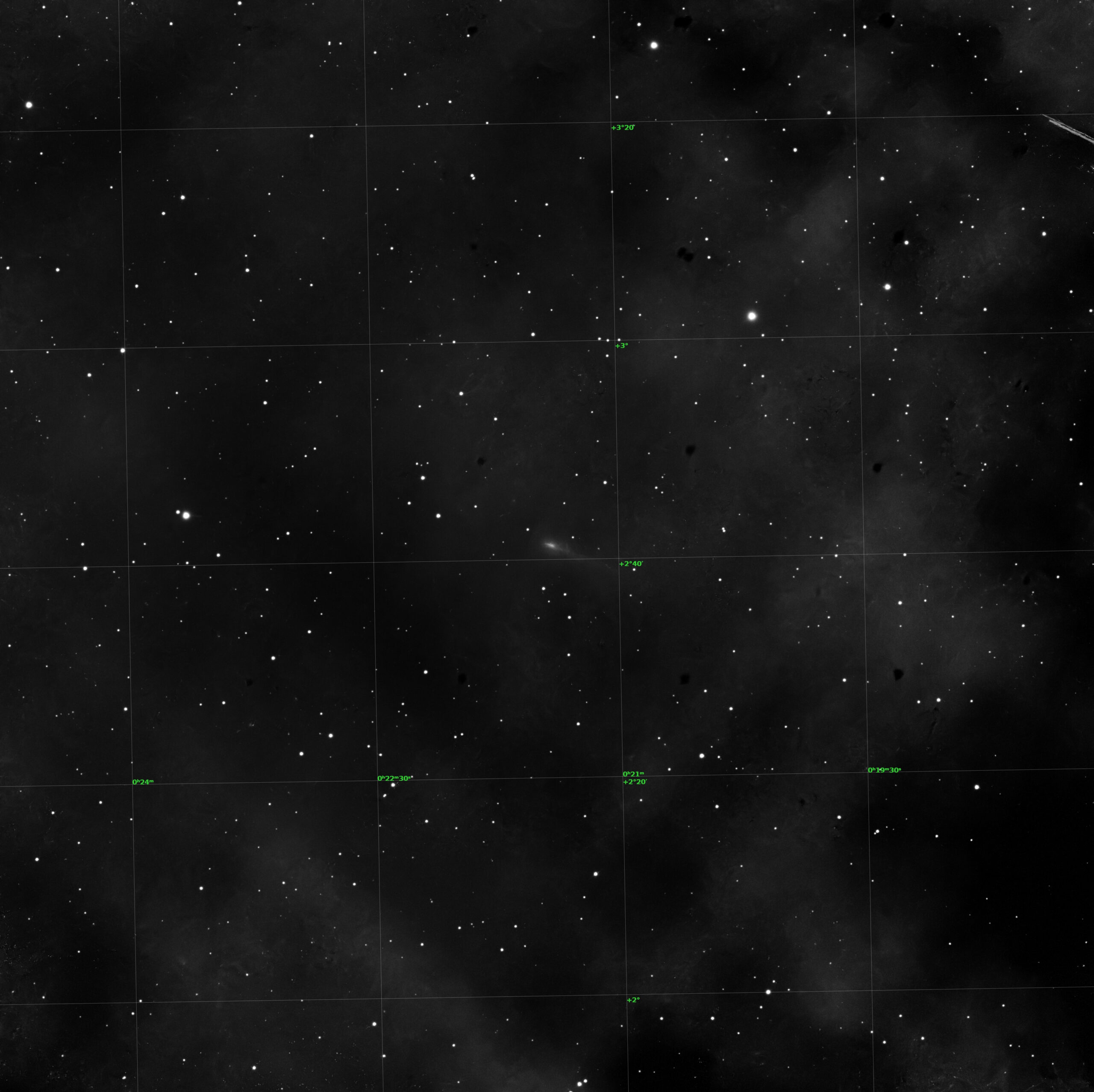
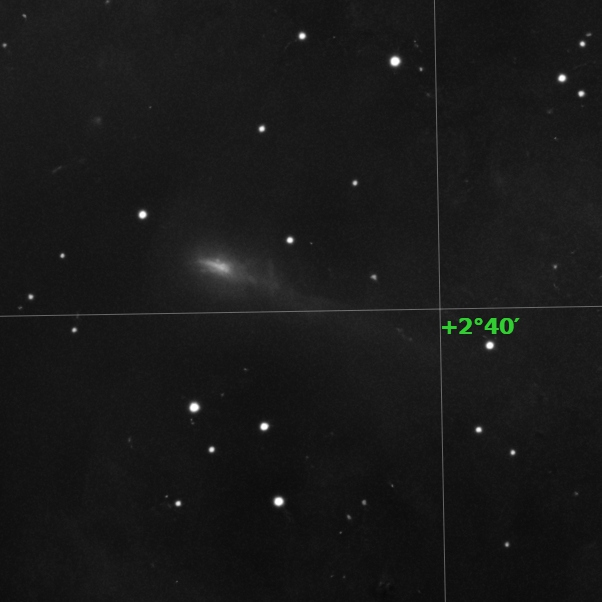
The night was clear, so I attempted to view Comet C220P/McNaught again (ra/dec: 00h21m31s, +02°41’46”). This time with the Vespera telescopes closer to the house. Trees were in the way, and I was not able to observe the comet with the Vespera 3 telescope. The Vespera Pro 2 telescope was able to lock on and track the comet, through an opening between the limbs and leaves of the trees next to the house. The moon was also bright and nearby in the sky. The composite view (131 images, 1310 sec) had a messy background. It needed a lot of processing (PixInsight, GrayScale, ABE, NoiseXterminator) but did show the comet. The unprocessed SOOT (straight out of the telescope) jpg and raw/tiff images for this observation are available to view on my PhotoShelter site.
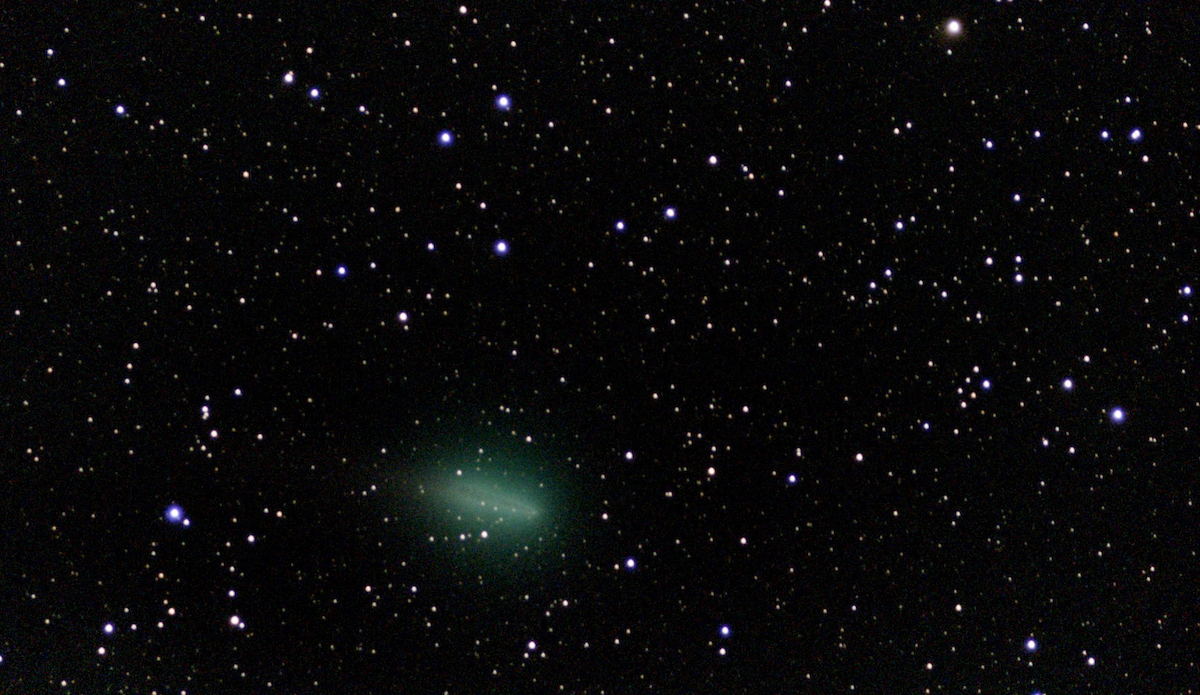
Comet 220P/McNaught viewed from my backyard with a Vespera Pro 2 Telescope. Exposure time 1310 sec (131 composite images). Image processed with PixInsight with added grid lines and annotation.Comet 220P/McNaught viewed from my backyard with a Vespera Pro 2 Telescope. Exposure time 1310 sec (131 composite images). Image processed with PixInsight (cropped view).
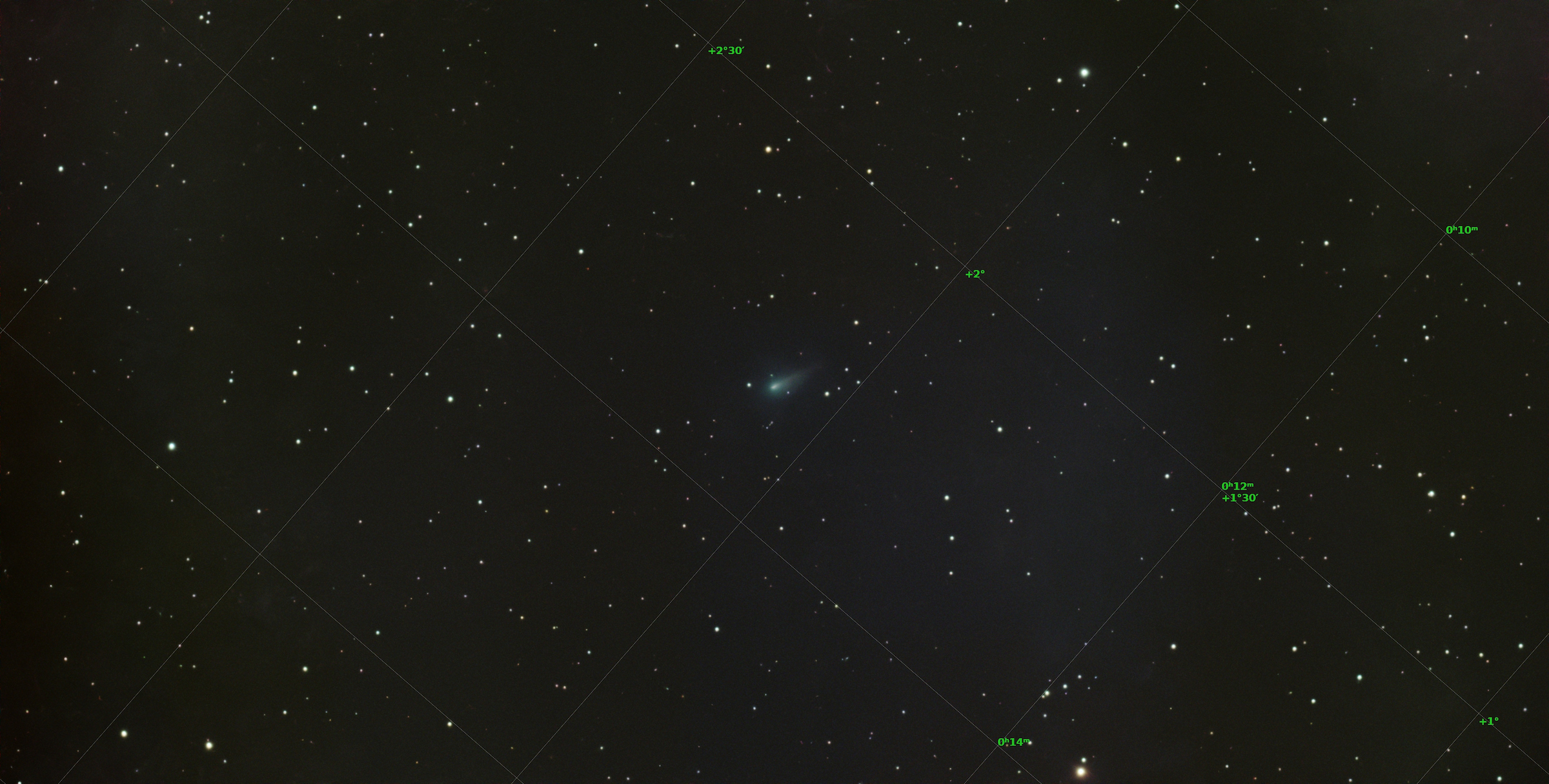
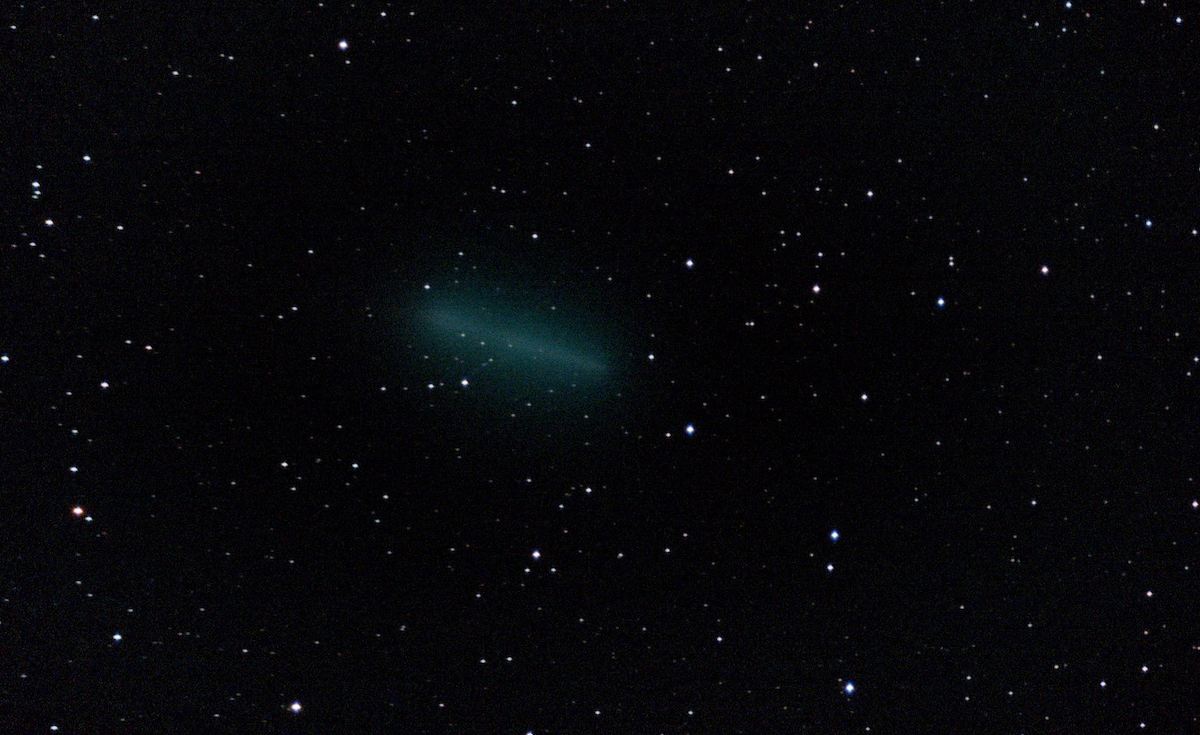
I saw a note on the Space Weather site that comet C220P/McNaught just increased in brightness. I looked up the coordinates (RA/Dec (J2000.0): 0h13m22s/+2°06’01”) using Stellarium. It looked like it may be visible from my location early in the morning. At this time of the year that is really early. Astronomical dawn starts at 02:36. I moved the Vespera 3 telescope to a location in the far backyard to have visibility to the east above the tree line where I thought the comet might be visible. At 03:00 after initializing the Vespera 3 telescope and programing the coordinates as a manual target I had the telescope look for the comet. I realized that there was still a tree in the way. So, I moved the telescope, reinitialized it, and had it look for the comet again. At 03:30 the Vespera 3 telescope found the comet, and I was able to get a 65 image composite (650 sec). Even though the sky was getting brighter, I followed up with three more observations at 03:46, 04:00, and 04:18. By the time of the last observation clouds started appearing and the sky was getting too bright. Sunrise was at 05:26.
Comet 220P/McNaught viewed from my backyard with a Vespera 3 Telescope. Composite of 65 (10 sec) exposures (10 min 50 sec). Processed with PixInsight (with grid overlay).
The comet C220P/McNaught was not very bright. The head of the comet has the green color from ionization of diatomic carbon (C2). There was a lot of early morning light pollution that needed to be removed with the PixInsight Automatic Background Extractor (ABE) tool. I added the grid to the image to get an estimate of the length of the tail. The comet is still approaching the sun (perihelion on 14-June) so I am not sure if I will have another opportunity to view it again. The unprocessed SOOT (straight out of the telescope) jpg and raw/tiff images for this and the other observations are available to view on my PhotoShelter site. Time-lapse videos recording the overnight viewing conditions (180° night sky and 360° little planet) for the night are available on my Time-Lapse site (05-June-2026).
I received a text notification from the folks at Vaonis that Comet C2025/A6 Lemmon would be visible in the early morning sky. I looked up the RA/Dec coordinates for the comet using Stellarium and programed them into targets for my Stellina, Vespera Classic, Vespera II, and Vespera Pro telescopes. The RA/Dec coordinates for 04:00 were 10h02m45s +41°05’14” which would be about 23° above the horizon to the northeast (near the big dipper). At 04:00 the comet was either blocked or just above the tree line. By 04:30 the comet could be observed by the telescopes.
Vespera Classic
The images are composites of 32 10-second images which is just over a 5-minute exposure. This exposure is long enough to see the comet tail. Longer exposures show movement of the comet head relative to the stars. The estimated magnitude of the comet is 13.1 (not yet visible to the unaided eye). The green color of the comet is due to diatomic carbon in the coma absorbing ultraviolet light and re-emitting it as green fluorescence. Note in three of the images a faint satellite trail is visible.
Leave a Reply