• Lunar Occultation of Jupiter (06-October-2026)

    Weather permitting, a rare lunar occultation of Jupiter was going to be visible at my location early the morning of 06-October. I previously recorded a lunar occultation of Mars (13-January-2025) with my Vespera telescopes. For that occultation the moon was full. This time the moon was a waning crescent. Jupiter would disappear behind the bright side of the moon’s crescent and reappear an hour later on the dark (illuminated by earthshine) side of the moon.

    There is a significant difference between the luminosity of the moon and Jupiter. This requires choices and compromises when setting up the observation parameters for recording the occultation. For the previous Mars occultation, I set up one telescope with the Vespera parameters optimized for lunar observations. The moon looked OK, but Mars was just a tiny dot. I set up a second telescope with the Vespera parameters optimized for the other planets. Mars appeared as a small orange disk, but the moon was over exposed. I was not able to see the two moons of Mars on that occasion.

    For this occultation of Jupiter, I also wanted to see if I could observe and record time that the four brightest moons of Jupiter (Callisto, Ganymede, Europa, and Io) disappear and reappear. I previously figured out a way to configure a Vespera telescope to observe Jupiter’s moons (18-February-2025) as a modified manual target.

    The evening sky was clear. I set up overnight plans for the Vespera telescopes. Some programed for lunar observations, and some programed to view Jupiter and the moons as modified manual targets. The telescopes needed to be in expert mode to set the manual target exposure time and gain. Object type: stars; Pointing type: indirect: Exposure time: 1 sec; and Gain: 0 dB. The right ascension (09h 31m 04s) and declination (+15°, 20′, 31″) for Jupiter at the time of the occultation for my location came from the Stellarium windows application.

    I started the overnight observation plans and went to bed. The occultation wouldn’t begin until after 04:15. Unfortunately, when I went out to check the telescopes, I realized that the moon was still below the tree line. Since I set the telescope observing Jupiter to use the “indirect” pointing mode it did initialize and still was able to point at Jupiter and be in focus. Most of the image was obscured by the tree leaves, and as expected the bright part of the moon’s crescent was overblown.
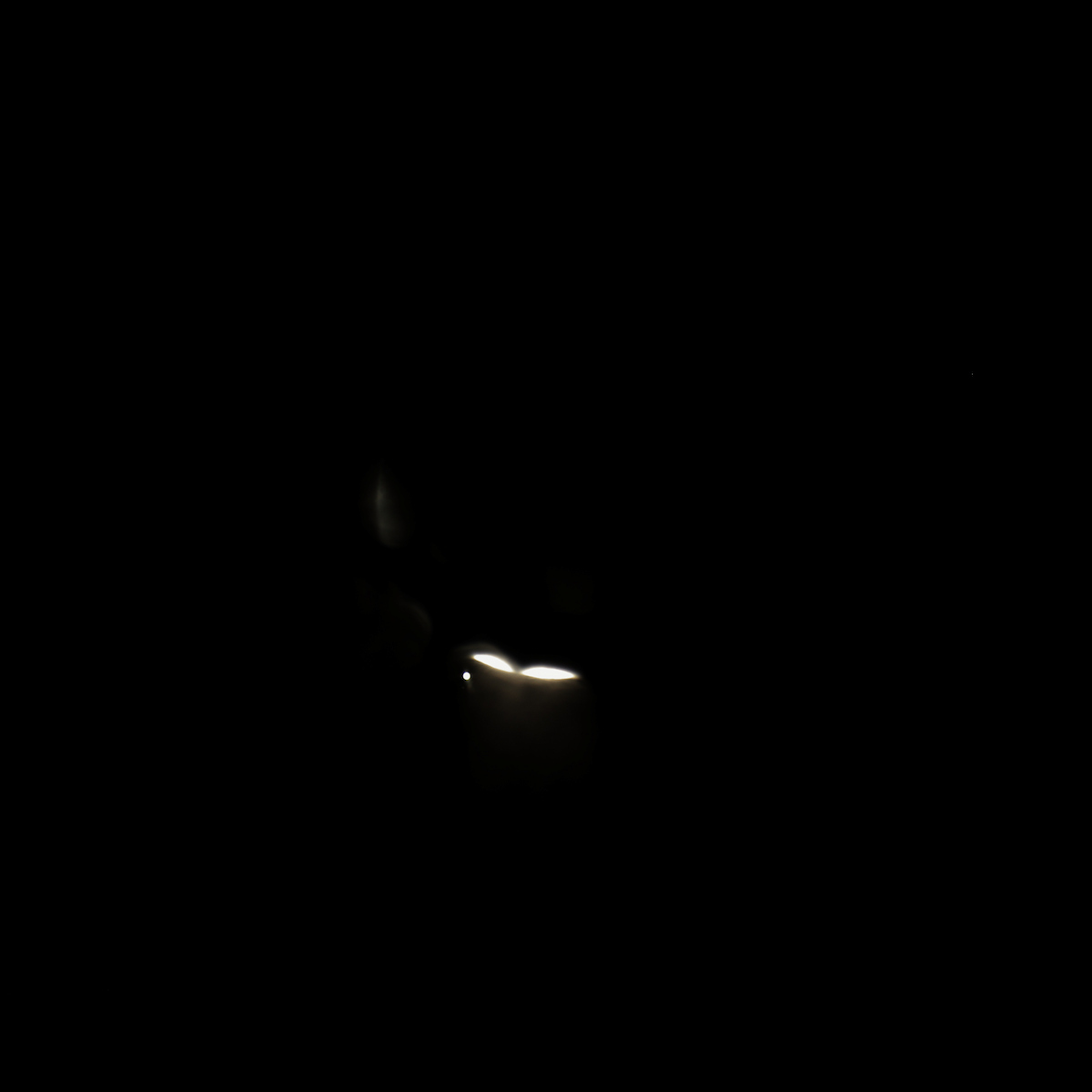
    Jupiter occultation viewed from my backyard with a Vespera Pro 1 Telescope. Exposure time:  sec.
    Jupiter occultation viewed from my backyard with a Vespera Pro 1 Telescope. Mostly hidden by tree leaves. The tiny white disk is Jupiter. The bright area is the Moon’s crescent mostly blocked by tree leaves.

    Even though observation of the start of the occultation failed, I still had a chance to view the end of the occultation. Jupiter and its moons wouldn’t reappear from behind the moon for nearly an hour. Rather than gamble that the moon would rise enough above the tree line, I moved the tripods and telescopes. The Vespera telescopes are light enough (~ 5 kg/11 lbs) to do this. After leveling the tripods, I reinitialized the telescopes and restarted the observation plan.

    From this location the telescopes successfully recorded Jupiter and its four largest moons reappearing. Europa (05:21:11), Callisto (05:23:19), Io (05:24:13), Jupiter (start 05:26:07, end 05:27:13), and finally Ganymede (05:28:39). The times are local (- 4 hours from UTC) as recorded by the telescope.

    I created two time-lapse videos of the event. The first time-lapse video from images recorded by a Vespera 3 telescope. The bright part of the moon’s crescent is slightly over exposed, and the dark part of the moon is not visible. Jupiter is definitely a disk, but with the Vespera telescopes too small to see any detail. In this video, Jupiter’s moons are not visible.


    Jupiter reappearing from behind the Moon. Images recorded with a Vespera 3 telescope.

    The second time-lapse video is from images recorded by a Vespera Pro 2 telescope. The images were processed with Capture One. I cropped out the bright part of the moon’s crescent. The dark side of the moon is barely visible. Jupiter is over exposed. For the manual target settings (type: stars) the shortest exposure time is 1 second, and the lowest gain is 0 dB. Also, the telescope only saves 8-bit jpg images in this mode. I would have been able to pull out more detail while processing the images if there was an option to collect and save 16-bit TIFF files during the observation.

    Europa, Callisto, Io, Jupiter, and Ganymede returning from behind the Moon. Images recorded with a Vespera Pro 2 telescope. Images processed with Capture One, and time-lapse video created with Photoshop. Note that the jpg images needed to be converted from gray scale to rgb to be processed by Capture One.

    The next image (post occultation event) was also taken by the Vespera Pro 2 telescope but in lunar observation mode. This mode uses a much faster exposure time (0.0038 sec). Details on the sunlit portion of the moon’s crescent are visible and properly exposed with the remainder of the moon being black. Jupiter is the small white disk above the moon. Jupiter’s moons are not visible in this image.
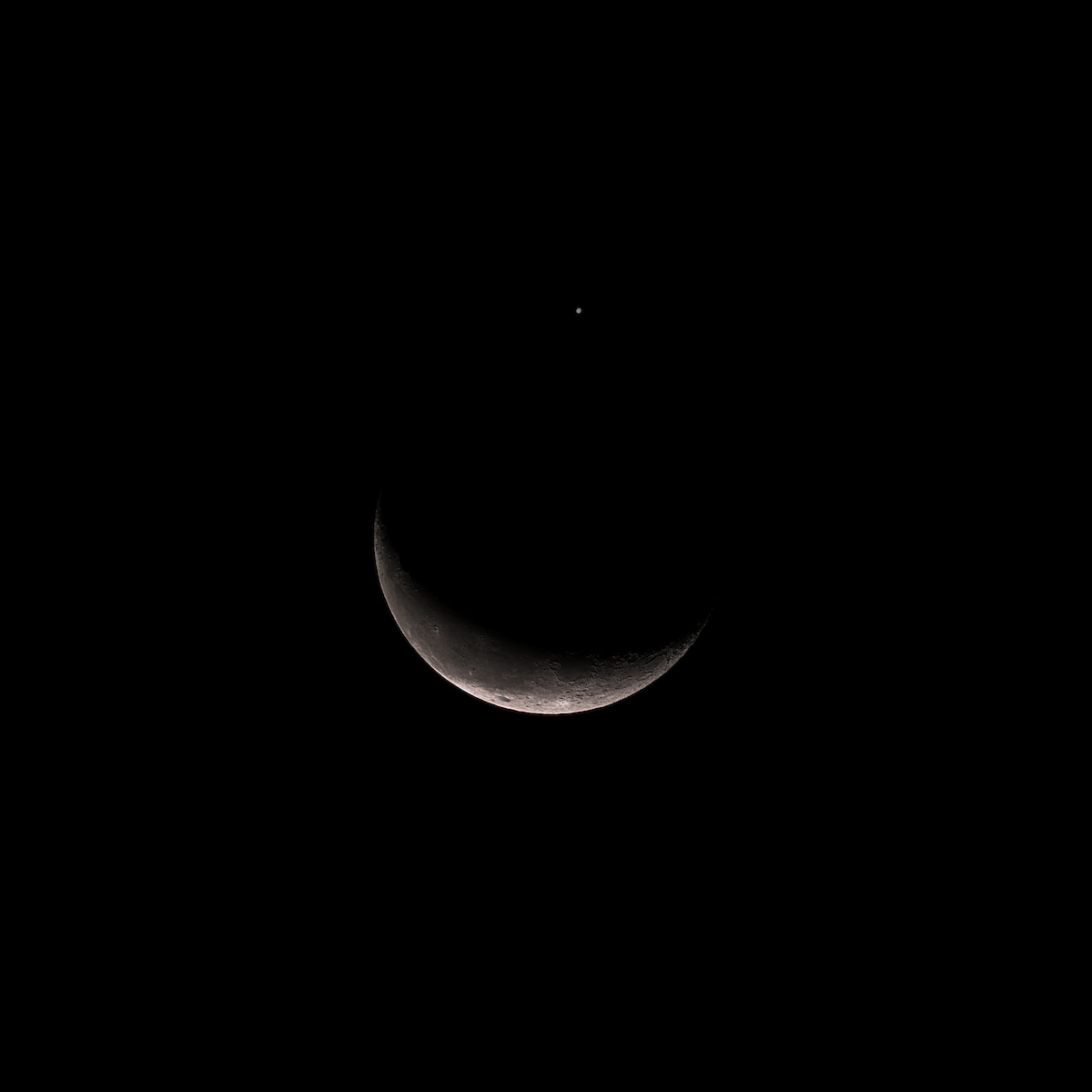
    Jupiter occultation viewed from my backyard with a Vespera Pro 2 Telescope. Exposure time: 0.038 sec.
    Jupiter occultation viewed from my backyard with a Vespera Pro 2 Telescope. Exposure time: 0.038 sec. Full scale image from the telescope (3536 x 3536 pixels).

    As an experiment, I used Topaz Photo to smooth and scale-up the image of Jupiter. I started with a 128 x 128 pixel crop of Jupiter from the above image and let Topaz scale it 4x. Are the bands real, or AI artifacts?
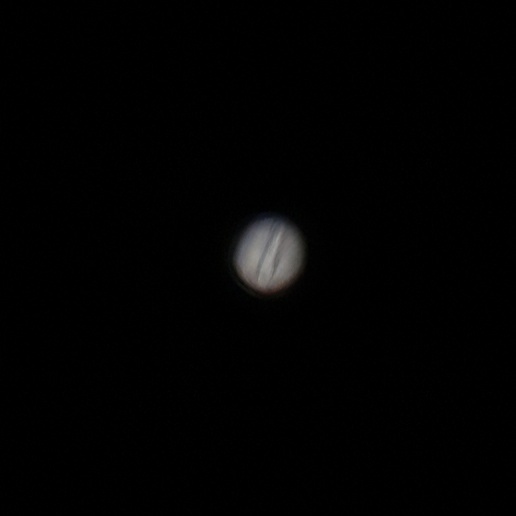
    Jupiter occultation viewed from my backyard with a Vespera Pro 2 Telescope. Exposure time:  sec.
    Jupiter after the image cropped and upscaled (high fidelity 2) with Topaz Photo. Image size (516 x 516 pixels). Are the bands real, or AI artifacts?

    Leave a Reply

    Your email address will not be published. Required fields are marked *

  • Comet 220P/McNaught (07-September-2026)

    Although comet C220P/McNaught is dimming, I continue my observations with the Vespera telescopes. The Manual Targets in Singularity were updated with the new coordinates for the comet obtained from Stellarium (RA/Dec: 03h 24m 31s; +08° 28′ 13″). Based on my previous study (20261006) I configured the object type as ‘Cluster’. Because the comet is getting dimmer, I increased the gain to 24 dB for Vespera 1, Vespera 2, and Vespera Passengers; and to 20 dB for Vespera 3, Vespera Pro 1, and Vespera Pro2.

    The comet is still visible to the telescopes. The tail, still > 0.5° long is fading. According to the Comet Observers Database (COBS) the visual magnitude of the comet was 11.2 for the night. It will be interesting to see how much longer I will be able to observe comet 220P/McNaught with the Vespera telescopes.

    The following slideshows include the straight out of the telescope (SOOT) images and images processed with PixInsight. For scale, I’ve included annotated and cropped images (1.0° FOV width). All of the images including the 16-bit RAW/TIFF files are available on my PhotoShelter site (20260907). Click on the i below the slideshow to view the image captions.


    Vespera 1 Telescope


    Vespera Passengers Telescope


    Vespera 2 Telescope


    Vespera 3 Telescope


    Vespera Pro 1A Telescope


    Vespera Pro 1B Telescope


    Vespera Pro 2 Telescope


    Links to my previous observations of comet 220P/McNaught: 20260606, 20260609, 20260616, 20260810, 20260811, 20260815, 20260816, 20260819, 20260820, 20260824, 20260825, 20260826, 20260829, 20260830, 20260906


    Leave a Reply

    Your email address will not be published. Required fields are marked *

  • Comet 220P/McNaught (06-September-2026)

    After nearly a week of rain and cloudy nights the ClearNightSky forecast looked good for continuing the observation of comet C220P/McNaught. The Waning Crescent moon is dimmer (~24% illuminated) than the last observation. I updated the manual target coordinates (RA/Dec: 03h 23m 35s; +08° 33′ 22″) for the comet in Singularity and started an overnight observation plan.

    The comet is dimming, and the tail is less visible. According to the Comet Observers Database (COBS) the visual magnitude of the comet was 11.0 for the night.

    The following slideshows include the straight out of the telescope (SOOT) images and images processed with PixInsight. For scale, I’ve included annotated and cropped images (1.0° FOV width). All of the images including the 16-bit RAW/TIFF files are available on my PhotoShelter site (20260906). Click on the i below the slideshow to view the captions with information about each image.


    Vespera 1 Telescope


    Vespera Passengers Telescope


    Vespera 2 Telescope


    Vespera 3 Telescope


    Vespera Pro 1A Telescope


    Vespera Pro 1B Telescope


    Vespera Pro 2 Telescope


    Links to my previous observations of comet 220P/McNaught: 20260606, 20260609, 20260616, 20260810, 20260811, 20260815, 20260816, 20260819, 20260820, 20260824, 20260825, 20260826, 20260829, 20260830


    Leave a Reply

    Your email address will not be published. Required fields are marked *

  • Optimization Viewing Comet 220P/McNaught with Vespera Telescopes – Part 4

    The ClearNightSky forecast showed clear skies predicted for the whole night. I wanted to repeat the Part 3 results making observation of comet 220P/McNaught using the three target types (nebula, galaxy, or cluster). This time with the gain set to 15 dB or 20 dB. Mainly to confirm that “cluster” is the best manual target choice to minimize the issue of the center background gradient. It has been six nights since the last good observations and according to the Comet Observers Database (COBS) the visual magnitude of the comet dimmed to +11.0.

    The observations from the Vespera 3, Vespera Pro 1, and Vespera Pro 2 telescopes are shown below. These are the unedited, “straight out of the telescope” (SOOT) JPG images. Click on the i below the slideshow to see the caption with the Manual Target parameters.

    The “cluster” manual target observation type remains the best, with galaxy coming a close second. The comet and tail are more difficult to view in the images with “nebula” as the target type.


    Vespera 3 Telescope


    Vespera Pro 1A Telescope


    Vespera Pro 1B Telescope


    Vespera Pro 2 Telescope


    Leave a Reply

    Your email address will not be published. Required fields are marked *

  • Comet 220P/McNaught (30-August-2026)

    The ClearNightSky forecast didn’t look promising but showed some periods that the sky might be clear. I set up the telescopes continuing for more comet  Comet 220P/McNaught observations. I also wanted to further test the Manual Target object modes (nebula, galaxy, or cluster). The observing conditions ended up being marginal. The comet appeared fainter, and the tail shorter than the previous night. According to the Comet Observers Database (COBS) the visual magnitude was +10.3 (same as the previous night).

    The following slideshows include the straight out of the telescope (SOOT) images and images processed with PixInsight. For scale, I’ve included annotated and cropped images (0.5° and 1.0° FOV width). All of the images including the 16-bit RAW/TIFF files are available on my PhotoShelter site (20260830). Click on the i below the slideshow to view the image captions.


    Vespera 1 Telescope


    Vespera Passengers Telescope


    Vespera 2 Telescope


    Vespera 3 Telescope


    Vespera Pro 1A Telescope


    Vespera Pro 1B Telescope


    Vespera Pro 2 Telescope


    Links to my previous observations of comet 220P/McNaught: 20260606, 20260609, 20260616, 20260810, 20260811, 20260815, 20260816, 20260819, 20260820, 20260824, 20260825, 20260826, 20260829


    Leave a Reply

    Your email address will not be published. Required fields are marked *

  • Optimization Viewing Comet 220P/McNaught with Vespera Telescopes – Part 3

    Continuation of the bright center background gradient investigation and optimization of comet 220P/McNaught observations on Vespera telescopes. When setting up a manual target in Singularity there are three target types (nebula, galaxy, and cluster) for objects that the telescope will stack images. Up to this point, I use nebula as the target type. It is first in the list when selecting the type. For tonight’s observations I created manual targets using nebula, galaxy, or cluster, with either the default or increased gain.

    The results are shown in the unedited, “straight out of the telescope” (SOOT) JPG images below and are available in my PhotoShelter gallery. Click on the i below the slideshow to see the caption with the Manual Target parameters.

    The “cluster” target type is the clear winner, with galaxy coming in second. Other than the Vespera 1 telescope, observations with the nebula mode have the center background gradient problem.


    Vespera 1 Telescope


    Vespera Passengers Telescope


    Vespera 2 Telescope


    Vespera 3 Telescope


    Vespera Pro 1A Telescope


    Vespera Pro 1B Telescope


    Vespera Pro 2 Telescope


    Leave a Reply

    Your email address will not be published. Required fields are marked *

  • Comet 220P/McNaught (29-August-2026)

    After a couple of cloudy nights the ClearNightSky forecast looked good for continuing the observation of comet C220P/McNaught. However, the Waning Gibbous moon is bright (~98% illuminated) making the observation more challenging. I updated the manual target coordinates (RA/Dec: 03h 15m 18s; +09° 05′ 24″) for the comet in Singularity and started an overnight observation plan.

    The comet is fainter, and the tail is more than 0.5° long. According to the Comet Observers Database (COBS) the visual magnitude of the comet continues to dim and was 10.3 for the night.

    The following slideshows include the straight out of the telescope (SOOT) images and images processed with PixInsight. For scale, I’ve included annotated and cropped images (1.0° FOV width). All of the images including the 16-bit RAW/TIFF files are available on my PhotoShelter site (20260826). Click on the i below the slideshow to view the captions with information about each image.


    Vespera 1 Telescope


    Vespera Passengers Telescope


    Vespera 2 Telescope


    Vespera 3 Telescope


    Vespera Pro 1A Telescope


    Vespera Pro 1B Telescope


    Vespera Pro 2 Telescope


    Links to my previous observations of comet 220P/McNaught: 20260606, 20260609, 20260616, 20260810, 20260811, 20260815, 20260816, 20260819, 20260820, 20260824, 20260825, 20260826,


    Leave a Reply

    Your email address will not be published. Required fields are marked *

  • Comet 220P/McNaught (26-August-2026)

    The continuing observations of comet C220P/McNaught with my Vespera telescopes. Third night in a row that the night sky remained clear which has been unusual this spring and summer. I updated the manual target coordinates (RA/Dec: 03h 11m 33s; +09° 14′ 28″) for the comet in Singularity and started overnight observation plans for the Vespera telescopes.

    The head of the comet is green, and the tail remains nearly 1° long. According to the Comet Observers Database (COBS) the visual magnitude of the comet continues to dim and was 10.1 for the night.

    The following slideshows include the straight out of the telescope (SOOT) images and images processed with PixInsight. For scale, I’ve included annotated and cropped images (1.0° FOV width). All of the images including the 16-bit RAW/TIFF files are available on my PhotoShelter site (20260826). Click on the i below the slideshow to view the captions with information about each image.


    Vespera 1 Telescope


    Vespera Passengers Telescope


    Vespera 2 Telescope


    Vespera 3 Telescope


    Vespera Pro 1A Telescope


    Vespera Pro 1B Telescope


    Vespera Pro 2 Telescope


    Links to my previous observations of comet 220P/McNaught: 20260606, 20260609, 20260616, 20260810, 20260811, 20260815, 20260816, 20260819, 20260820, 20260824, 20260825


    Leave a Reply

    Your email address will not be published. Required fields are marked *

  • Comet 220P/McNaught (25-August-2026)

    The continuing observations of comet C220P/McNaught with my Vespera telescopes. I updated the manual target coordinates (RA/Dec: 03h 10m 15s; +09° 17′ 05″) for the comet in Singularity and started overnight observation plans for the Vespera telescopes.

    The head of the comet is green, and the tail is nearly 1° long. According to the Comet Observers Database (COBS) the visual magnitude of the comet was 10.0 for the night.

    The following slideshows include the straight out of the telescope (SOOT) images and images processed with PixInsight or Sky Color Studio. For scale, I’ve included annotated and cropped images (1.0° FOV width). All of the images including the 16-bit RAW/TIFF files are available on my PhotoShelter site (20260825). Click on the i below the slideshow to view the image captions.


    Vespera 1 Telescope


    Vespera Passengers Telescope


    Vespera 2 Telescope


    Vespera 3 Telescope


    Vespera Pro 1A Telescope


    Vespera Pro 1B Telescope


    Vespera Pro 2 Telescope


    Links to my previous observations of comet 220P/McNaught: 20260606, 20260609, 20260616, 20260810, 20260811, 20260815, 20260816, 20260819, 20260820, 20260824


    Leave a Reply

    Your email address will not be published. Required fields are marked *

  • Comet 220P/McNaught (24-August-2026)

    The continuing observations of comet C220P/McNaught with my Vespera telescopes. After several cloudy days and nights, the ClearNightSky forecast looked good for two or three nights. I updated the manual target coordinates (RA/Dec: 03h 09m 01s; +09° 19′ 20″) for the comet in Singularity and started overnight observation plans for the Vespera telescopes.

    The head of the comet is green, and the tail is nearly 1° long. According to the Comet Observers Database (COBS) the visual magnitude of the comet was 9.9 for the night.

    The following slideshows include the straight out of the telescope (SOOT) images and images processed with PixInsight . For scale, I’ve included annotated and cropped images (0.5° and 1.0° FOV width). All of the images including the 16-bit RAW/TIFF files are available on my PhotoShelter site (20260824). Click on the i below the slideshow to view the image captions.


    Vespera 1 Telescope


    Vespera Passengers Telescope


    Vespera 2 Telescope


    Vespera 3 Telescope


    Vespera Pro 1A Telescope


    Vespera Pro 1B Telescope


    Vespera Pro 2 Telescope


    Links to my previous observations of comet 220P/McNaught: 20260606, 20260609, 20260616, 20260810, 20260811, 20260815, 20260816, 20260819, 20260820


    Leave a Reply

    Your email address will not be published. Required fields are marked *

October 2026
S M T W T F S
 123
45678910
11121314151617
18192021222324
25262728293031

Search the website


David Mathre Avatar

About the author


Tag Cloud

Comet Comet 220P/McNaught Comet C2025/A6 Comet C2025/R2 Jupiter Moon occultation Optimization PixInsight Singularity Stellarium Stellina Telescope time-lapse Topaz Photo Vaonis Vespera Vespera Classic Vespera II Vespera III Vespera Passengers Vespera Pro Vespera Pro 2


Popular Categories